

What Percentage Of Women Do Not Leave Home Without Makeup On
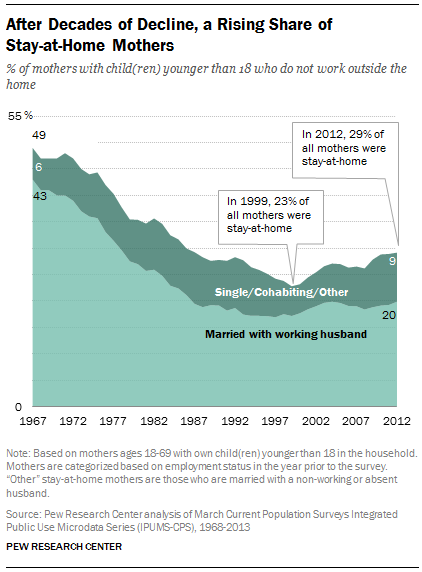 The share of mothers who do not piece of work outside the home rose to 29% in 2012, upwards from a modernistic-era low of 23% in 1999, co-ordinate to a new Pew Inquiry Centre analysis of government data.1 This ascent over the by dozen years represents the reversal of a long-term decline in "stay-at-domicile" mothers that had persisted for the terminal three decades of the 20th century.2 The recent turnaround appears to exist driven by a mix of demographic, economic and societal factors, including rising immigration as well as a downturn in women's labor strength participation, and is fix against a backdrop of continued public ambivalence about the touch of working mothers on immature children.
The broad category of "stay-at-habitation" mothers includes not only mothers who say they are at home in order to intendance for their families, but also those who are at abode because they are unable to find work, are disabled or are enrolled in school.
The largest share consists of "traditional" married stay-at-abode mothers with working husbands. They made up roughly two-thirds of the nation'southward 10.4 1000000 stay-at-abode mothers in 2012. In addition to this group, some stay-at-domicile mothers are single, cohabiting or married with a husband who does non work.
The economic ups and downs of the past decade likely influenced mothers' decisions on whether to stay home or go to piece of work. The share of mothers staying home with their children rose from 2000 to 2004, but the ascension stopped in 2005, amid economic doubt that foreshadowed the official outset of the Bang-up Recession in 2007. The increase in both number and share eventually resumed: From 2010 to 2012, the share of stay-calm mothers (29%) was 3 percentage points college than in 2008 (26%), at the height of the recession.
Affluent Married Stay-at-Home Mothers
Although they are often in the media spotlight, relatively few married stay-at-home mothers (with working husbands) would qualify equally highly educated and affluent. This grouping is sometimes called "opt-out mothers," although some researchers say they may have been pushed out of the workforce due to work-family conflicts.
In 2012, nearly 370,000 U.S. married stay-at-home mothers (with working husbands) had at to the lowest degree a primary'south degree and family unit income exceeding $75,000. This group accounted for five% of married stay-at-dwelling house mothers with working husbands.
These affluent stay-at-dwelling house mothers, who have a median family unit income of nearly $132,000, are somewhat older than married stay-at-home mothers with working husbands overall, according to 2011-2012 data. Half are ages 35-44, while just nineteen% are younger than 35. As is true of all married stay-calm mothers, almost half of this elite group (53%) has at least one child age 5 or younger at home.
These women stand out from other married stay-at-home mothers in that they are disproportionately white or Asian. About 7-in-10 (69%) are white, and fully 19% are Asian. Only 7% are Hispanic, and 3% are black.
A growing share of stay-at-abode mothers (6% in 2012, compared with i% in 2000) say they are home with their children because they cannot notice a chore. With incomes brackish in recent years for all but the higher-educated, less educated workers in detail may weigh the cost of child care against wages and decide it makes more economic sense to stay home.3
Married stay-at-habitation mothers are more likely than single or cohabiting stay-at-domicile mothers to say they are not employed because they are caring for their families (85% said this in 2012). By comparison, just 41% of single stay-at-domicile mothers and 64% of cohabiting mothers give family unit care as their primary reason for being abode, according to census data. They are more than likely than married stay-at-home mothers to say they are sick or disabled, unable to discover a chore, or enrolled in school.
The recent rise in stay-at-abode motherhood is the flip side of a dip in female labor strength participation after decades of growth.4 The causes are debated, merely survey data do non indicate the dip will go a plunge, as most mothers say they would similar to work, part time or total time.
(Stay-calm fathers, while not the focus of this written report, represent a small just growing share5 of all stay-at-dwelling parents.6)
Demographic Characteristics
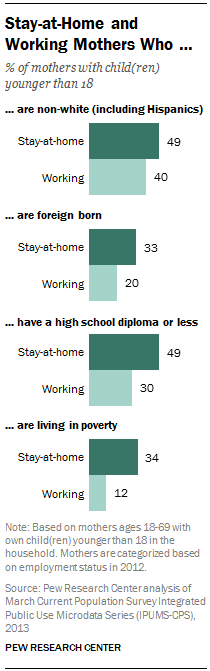 The share of stay-at-home mothers has risen since 2000 amid married mothers with working husbands and single mothers. Whether married, unmarried or cohabiting, each group of stay-at-home mothers has a demographic profile distinctly different from that of their working counterparts—and also different from each other's. No matter what their marital status, mothers at domicile are younger and less educated than their working counterparts. Among all stay-at-habitation mothers in 2012, about 4-in-ten (42%) were younger than 35. This compares with roughly a tertiary (35%) of working mothers. Half (51%) of stay-at-dwelling house mothers intendance for at to the lowest degree one child historic period v or younger, compared with 41% of working mothers.
Fully 49% have a high school diploma or less, compared with 30% of working mothers. In addition, stay-at-dwelling house mothers are less likely than working mothers to be white (51% are white, compared with 60% of working mothers) and more than likely to be immigrants (33% vs. 20%). The overall rise in the share of U.Due south. mothers who are foreign born, and rapid growth of the nation's Asian and Latino populations, may business relationship for some of the contempo increase in the share of stay-at-domicile mothers.
One of the about striking demographic differences between stay-at-home mothers and working mothers relates to their economic well-existence. Fully a third (34%) of stay-at-home mothers are living in poverty, compared with 12% of working mothers.
There also is substantial variation among stay-at-home mothers. Those who are married with working husbands generally are ameliorate off financially than the other groups. They are more highly educated, and relatively few are in poverty (xv%), compared with a majority of other stay-at-home mothers. Married stay-at-habitation mothers (whether their husbands work or not) also are markedly more than likely than unmarried or cohabiting stay-at-home mothers to be foreign born. Unmarried or cohabiting stay-at-abode mothers are younger than their married counterparts; most are younger than 35, compared with about four-in-ten married stay-at-home mothers.
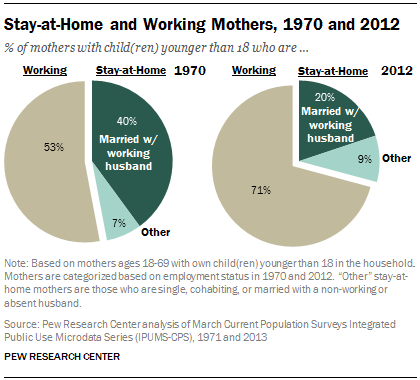 Amongst all mothers, the share who are stay-calm mothers with working husbands fell to xx% in 2012 from 40% in 1970. Amidst all stay-at-home mothers, those who are married with working husbands make up the largest share (68% in 2012), merely that has declined significantly from 1970, when it was 85%. Every bit marriage rates have declined amidst U.S. adults, a growing share of stay-at-dwelling mothers consists of single mothers (twenty% in 2012, compared with 8% in 1970). Well-nigh 5% are cohabiting mothers, and 7% are married mothers whose husbands do not work.
Other meaning changes in the nation's demographics since 1970 also have reshaped the profile of stay-at-dwelling mothers. As women's education levels have risen, 25% of 2012's stay-at-home mothers were college graduates, compared with 7% in 1970. And xix% in 2012 had less than a high school diploma, compared with 35% in 1970. In spite of these educational gains, the share of stay-at-home mothers living in poverty has more than doubled since 1970.
This report analyzes the prevalence and characteristics of U.Due south. mothers living with their children younger than age 18, using information from the Demography Bureau's Electric current Population Survey. The assay looks at trends from 1970 to 2012,seven focusing most closely on patterns since 2000, including the years surrounding the Great Recession from 2007 to 2009. In add-on, the report compares time use of mothers at dwelling house and mothers at work, using information from the 2003-2012 American Time Use Survey. Information technology also explores public stance findings about mothers at home and at work.
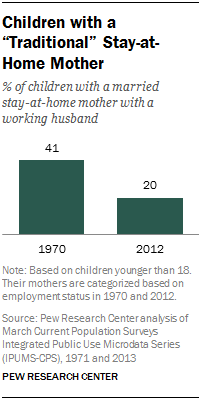 The changing circumstances of mothers have articulate implications for the nation'south children. Almost three-in-10 children (28%) in the U.S. today are being raised by a stay-at-habitation female parent. This totaled 21.ane one thousand thousand in 2012 out of 74.2 one thousand thousand Americans younger than 18,eight up from 17.three million (24% of children) in 2000. In 1970, 48% of children (34 meg) had a female parent who stayed at domicile.
Ane-in-five U.S. children today are living in a household with a married stay-at-home mother and her working husband. In 1970, 41% of children lived in this blazon of household. In 2012, 5% of children (3.7 million) lived with a single stay-at-home female parent, and one% (992,000) with a cohabiting stay-at-habitation mother. An additional 1.five 1000000 children (2% of the total) lived with married parents who were both out of the paid workforce.
About children today, regardless of race or ethnicity, are growing up with a working mother. Asian and Hispanic children are the most likely to be raised by stay-at-dwelling mothers—37% and 36%, respectively, were in 2012. That compares with 26% of white children and 23% of black children.
Time Employ of Mothers
Analysis of time-use diaries finds that mothers at home spend more hours per week than working mothers on child care and housework,nine equally well as more fourth dimension on leisure and slumber. Time use also varies among unlike groups of mothers at home: Married stay-at-dwelling mothers put more than time into child care and less into leisure than their single counterparts.
Overall, mothers at home spend eighteen hours a week on child careten, compared with 11 hours for working mothers, a seven-60 minutes divergence. The child-care fourth dimension gap between mothers who work outside the home and those who do not is largest amongst married mothers with working husbands. There is a nine-hour disparity in weekly child-intendance hours of stay-at-home married mothers with employed husbands (20 hours) compared with working married mothers with employed husbands (eleven hours). The deviation for cohabiting mothers is seven hours, and information technology is v hours for single mothers.
Public Opinion
 Public stance has grown more supportive of working mothers over time. When the General Social Survey starting time asked in 1977 whether a working mother "tin establish simply equally warm and secure a relationship with her children" as a mother who stays home, only half of Americans (49%) agreed. That share mostly rose until 1994, when it was 70%, then declined into the low to mid-60s over the following decade. Since 2008, the share agreeing has reached lxx% or more.
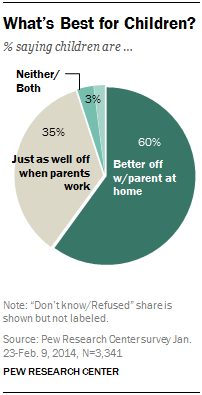
However, Americans too continue to think that having a female parent (or parent) at domicile is best for a kid. In a recent Pew Research survey, 60% of respondents said children are better off when a parent stays dwelling house to focus on the family, compared with 35% who said children are merely as well off with working parents.
Most the Data
Findings in this report are based primarily on data from the Electric current Population Survey and the American Fourth dimension Use Survey.
Current Population Survey Information: Analyses of the trends and demographic characteristics of U.South. mothers are based on information from the 1971-2013 Almanac Social and Economic Supplement (ASEC) of the Current Population Survey (CPS), which is conducted jointly past the U.S. Demography Agency and the Bureau of Labor Statistics. These information are collected each March and included virtually 90,000 household interviews in 2013. The data were obtained from the Integrated Public Employ Microdata database (IPUMS-CPS), provided past the Academy of Minnesota. Farther data about the IPUMS is available at http://world wide web.ipums.org.
The Pew Research Heart analyses are based upon all women ages eighteen-69 who report living with at least one of their own children younger than 18 years of age. Responses include all biological children, adopted children and stepchildren.
While the analyses based on time-use information classify mothers and their husbands or partners based upon their current employment condition, the demographic analyses categorize them based upon their employment status during the prior yr. This is similar to the approach adopted by the U.Due south. Census Bureau.
American Time Use Information: The time-utilise findings presented in Chapter 3 are based on the American Time Use Survey (ATUS) 2003-2012. The ATUS is the nation's largest survey on time use and the only federal survey providing such information. It was launched in 2003 by the Bureau of Labor Statistics. The ATUS sample is nationally representative and drawn from the Current Population Survey. The ATUS interviews a randomly selected private age 15 or older from a subset of the households that complete their eighth and terminal interview from the CPS. Interviews are conducted over the telephone. The monthly sample is divided into iv randomly selected panels, one for each calendar week of the month. It is also split evenly between weekdays and weekends. The response rate for each year has been above 50% since the survey started in 2003. For more data on the ATUS methodology, see http://world wide web.bls.gov/tus/atususersguide.pdf.
The Pew Research Middle analyses are based on the yearly ATUS information from 2003 to 2012. To increase the sample sizes for mothers in dissimilar type of families, we pooled the data for all years. The sample size for all stay-at-home mothers ages 18 to 69 with their own child(ren) younger than 18 is 10,535, including 6,640 married mothers who are not employed and whose husbands are working for pay; 266 stay-at-home mothers who are cohabiting; and two,558 unmarried mothers who are not employed. At that place are ane,071 married (due north=970) or cohabiting mothers (due north=101) who are not employed and whose husbands/partners are not employed either. These mothers are included in the overall stay-at-habitation mothers, just not analyzed separately.
Employment status in the ATUS is measured for the previous calendar week; this measure differs from Current Population Survey data used elsewhere in this report, for which employment status is measured for the prior twelvemonth. The ATUS data files were downloaded from ATUS-X (world wide web.atusdata.org).* The data were weighted to adjust for nonresponse, oversampling and weekend and weekday distribution.
*Sandra L. Hofferth, Sarah M. Overflowing, and Matthew Sobek. 2013. American Time Use Survey Data Extract System: Version 2.4 [Car-readable database]. Maryland Population Inquiry Middle, Academy of Maryland, College Park, Maryland, and Minnesota Population Heart, University of Minnesota, Minneapolis, Minnesota.
Source: https://www.pewresearch.org/social-trends/2014/04/08/after-decades-of-decline-a-rise-in-stay-at-home-mothers/
Posted by: weaverhousee82.blogspot.com
0 Response to "What Percentage Of Women Do Not Leave Home Without Makeup On"
Post a Comment