

Is Soap & Glory Makeup Hypoallergenic
Reading time: 12 minutes
Every time you log in to a website with your Facebook account or elevate a drop-off pivot across a Google map in the ride-hailing app, the application y'all use communicates with Google or Facebook via a spider web API. An API or an application programming interface is a course of agreement betwixt web services on how they are going to commutation information, e.g. retrieve a map or your business relationship credentials. The data itself is structured in messages that systems send to each other. Once y'all open, say, the Uber app, your phone sends a bulletin request to Google Maps, and Google returns the map itself.
And if you lot've always dealt with spider web services, you probably know that in that location's more than one way to build a web API. The modernistic spider web is ruled past APIs that use the Rest pattern. It's a lightweight and efficient data substitution. But sometimes, you'd come across another arroyo – the Lather protocol. It doesn't brag about its simplicity and it'due south not as fast equally REST. Merely you'd be surprised how common it is in corporate data exchange, considering SOAP has its merits.
In this article, we'll effigy out how Lather works, why it'south so common across corporate users, and how it differs from REST.
Time for some words of caution: This article uses tech terms like server, customer, protocols, etc. Even though nearly of them are explained, if you're still uncertain, take a await at our beginner-friendly article about spider web architecture. It'southward a handy jumping-off point for those of you just sticking your tech toes in the water.
What is SOAP?
SOAP or Simple Objects Access Protocol is a spider web communication protocol designed for Microsoft back in 1998. Today, information technology'south mostly used to expose spider web services and transmit information over HTTP/HTTPS. But it'due south non limited to them. Lather, unlike the Balance pattern, supports the XML data format simply and strongly follows preset standards such as messaging structure, a set of encoding rules, and a convention for providing procedure requests and responses.
The born functionality to create spider web-based services allows SOAP to handle communications and make responses linguistic communication- and platform-independent.
While most web information exchange happens over Residuum exchange, SOAP isn't disappearing anytime shortly, because information technology'south highly standardized, allows for automation in certain cases, and it'southward more secure. Let's have a await at the principal SOAP features.
SOAP works with XML only
Web-transmitted data is usually structured in some fashion. The two most popular information formats are XML and JSON.
XML (or Extensible Markup Language) is a text format that establishes a ready of rules to structure messages as both man- and motorcar-readable records. But XML is verbose as it aims at creating a web document with all its formality. JSON, on the other manus, has a loose structure that focuses on the data itself. Have a look at the epitome below to become the idea.
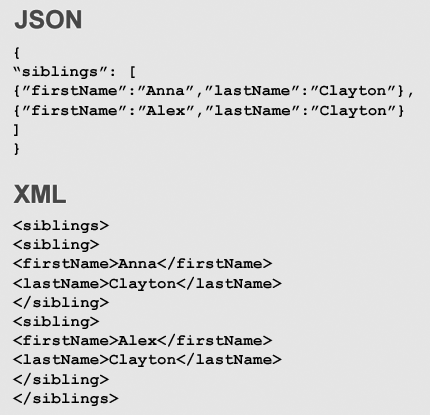
You see that numerous ending tags in XML make it much longer. Thanks PCMag for the image.
As we've mentioned, when sending requests and response letters inside web applications, Soap requires XML exchange betwixt systems. And when the request is received, Lather APIs transport messages back XML-coded only.
Besides the data format, SOAP has another level of standardization – its message structure.
Soap message construction
XML isn't the just reason Soap is considered verbose and heavy compared to Residue. It'due south also the way SOAP messages are composed. Standard Soap API requests and responses appear as an enveloped message that consists of four elements with specific functions for each one.
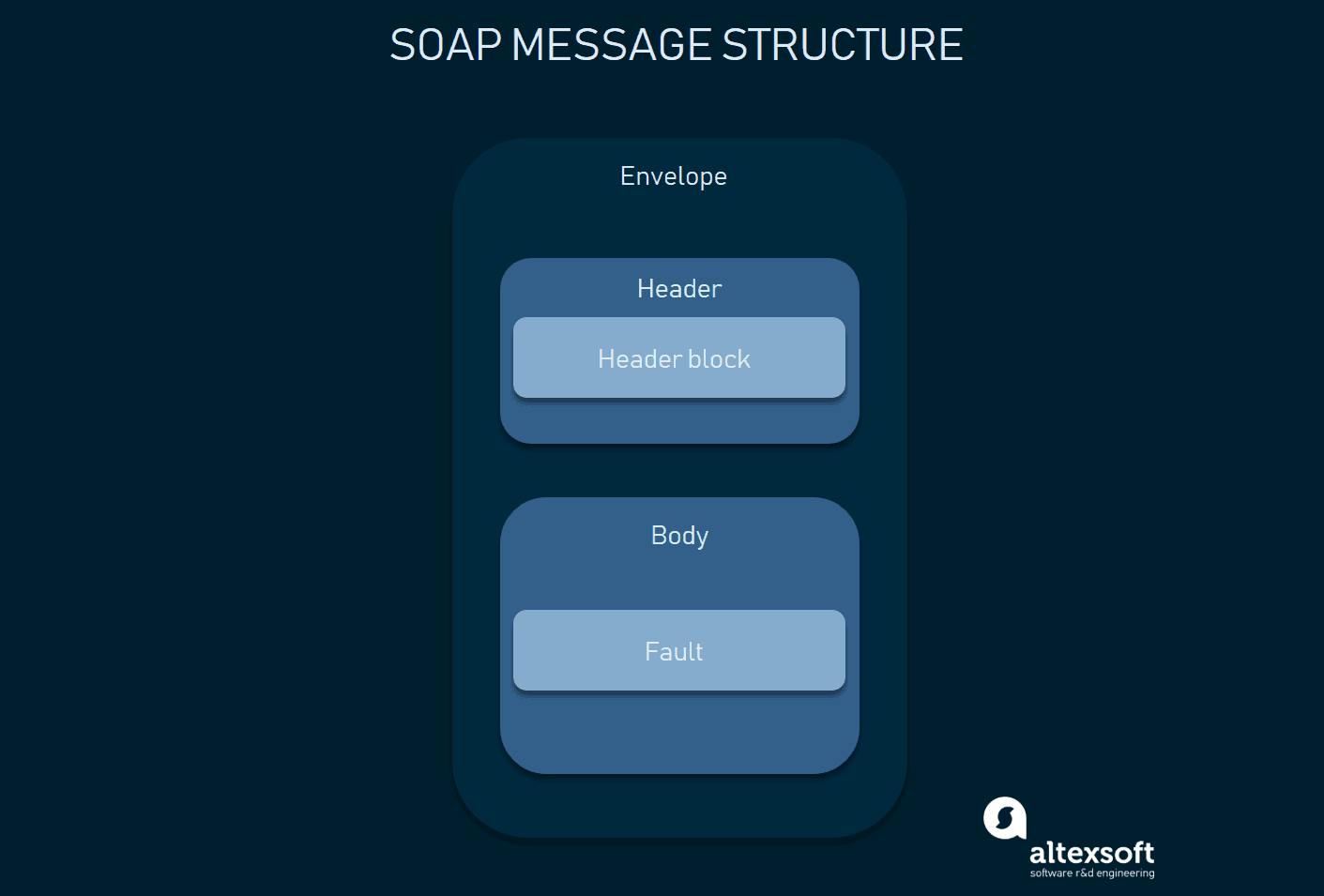
Headers and mistake elements are optional
Envelope is the core and essential chemical element of every message, which begins and concludes messages with its tags, enveloping information technology, hence the name.
Header (optional) determines the specifics, extra requirements for the message, e.thousand. authentication.
Trunk includes the asking or response.
Fault (optional) shows all data about any errors that could emerge throughout the API request and response.
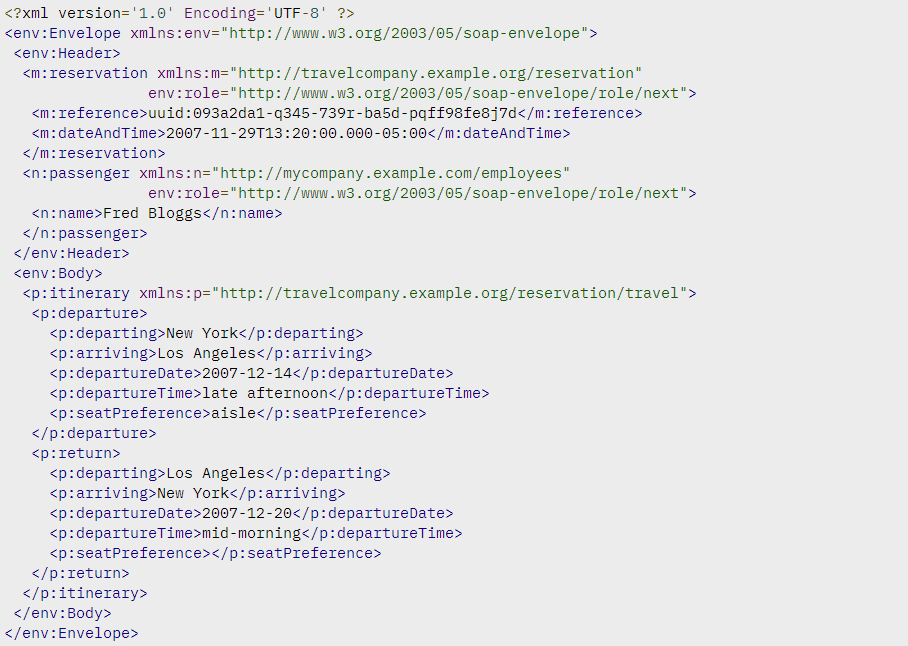
An instance of the Lather message. Image source: IBM
Lather extensibility with WS standard protocols
That said, Lather itself provides bones structural elements of the message. Only information technology doesn't dictate what goes into headers and bodies. Basically, you can customize these contents as appropriate.
But as web applications mostly solve common sets of issues, after the SOAP release, the main protocol has been augmented by numerous standard protocols that specify how you do things. All these protocols are commonly marked WS-(protocol name), east.thousand. WS-Security, WS-ReliableMessaging. They were contributed by different organizations, including Microsoft, IBM, Haven, and others.
Standard protocols cover multiple areas and facets of SOAP use:
- Security
- Messaging
- Transactions
- Metadata, etc.
The cool thing nearly these protocols is that yous can choose which of those yous use. This is ordinarily described as Soap extensibility. For case, if y'all demand your financial transactions to be secure, y'all tin apply WS-Diminutive Transaction that are Acid-compliant.
ACID compliance
Acid stands for Atomicity, Consistency, Isolation, and Durability, which is an enterprise-grade transaction quality and one of the reasons why SOAP is still used when exchanging sensitive information in enterprise architectures.
Acid compliance means that transactions see the following requirements:
Atomicity. Multiple connected transactions either work every bit a single unit of measurement or don't work at all. Sometimes this is called an all-or-none arroyo. This ready of transactions is compared to an cantlet, which consists of multiple tightly connected elements.
Consistency. If some part of a transaction fails, the arrangement rolls back to its initial country.
Isolation. Transactions are independent of each other.
Durability. Fifty-fifty if the system fails, completed transactions remain.
If you use WS-Atomic Transaction, which is another standard protocol, you'll be able to attain ACID-compliance.
Web Service Description Language (WSDL) document
One of the major features of Lather APIs is that they almost always use a WSDL certificate.
Simply put, a WSDL document is an XML description of a web service. It acts equally a guideline of how to communicate with a web service, defining the endpoints and describing all processes that could be performed by the exposed applications. These may include data types existence used inside the SOAP letters and all actions available via the web service. Thus, a WSDL file serves as a signed contract between a client and a server.
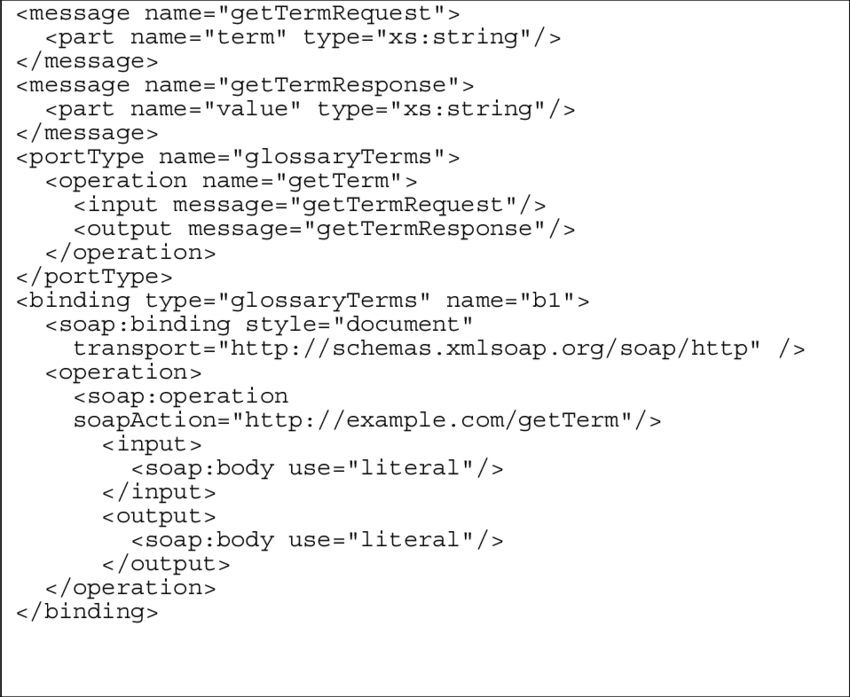
This is how WSDL certificate may expect. Image source: Researchgate.net
The cool thing about WSDL is that it allows you to generate client-side lawmaking in various languages and start messaging the server correct away. While not all Soap APIs leverage WSDL documents, their use is and then popular because it helps different programming languages and IDEs apace prepare the communication.
More on technical documentation in our dedicated article.
Transfer protocols: HTTP, TCP, SMTP, FTP, and more than
In layman terms, a transfer protocol is a fix of rules and commands used to transfer data over the internet. In that location are low-level protocols similar IPv4, which simply delivers data packets from one betoken to some other. There are higher transfer layers, like TCP, which ensures that data is indeed delivered. And, finally, there are application-level protocols that are used by web browsers to communicate with spider web servers, but don't take accuse of the connectedness itself.
SOAP supports a variety of transfer protocols, both high- and depression-level ones. For example, Lather allows for messaging via TCP (Transaction Control Protocol), a low-level information substitution method that works between ports via an IP network. You tin go for the SMTP (Unproblematic Mail Transfer Protocol) option, which is a communication protocol for electronic mail transmission, FTP (File Transfer Protocol), and whatever other transfer method that supports text information exchange.
Does it brand any sense to ship data using other protocols than HTTP/HTTPS? In most cases, it doesn't. Soap was primarily designed to piece of work with HTTP. But there may be scenarios, such as security constraints, server requirements, solution architectures, or simply speed that volition benefit from this SOAP versatility.
Soap WS-Security
Soap is appreciated for its ability to integrate the WS-Security feature. This ready of protocols determines how to implement security within the transactions and suggests information privacy and integrity. Also, it allows for encryption and cryptographic signing.
What WS-Security does is permit your letters to be encrypted non only by HTTPS (which already contains encryption), merely also on the message level, having authentication data in the header element. It's needed to make sure that if your data travels out of HTTPS when it reaches the server, it can only be read by the right process within this server, rather than the correct server itself. As there tin can be some data preprocessing happening on the server side earlier the bulletin reaches its designated process.
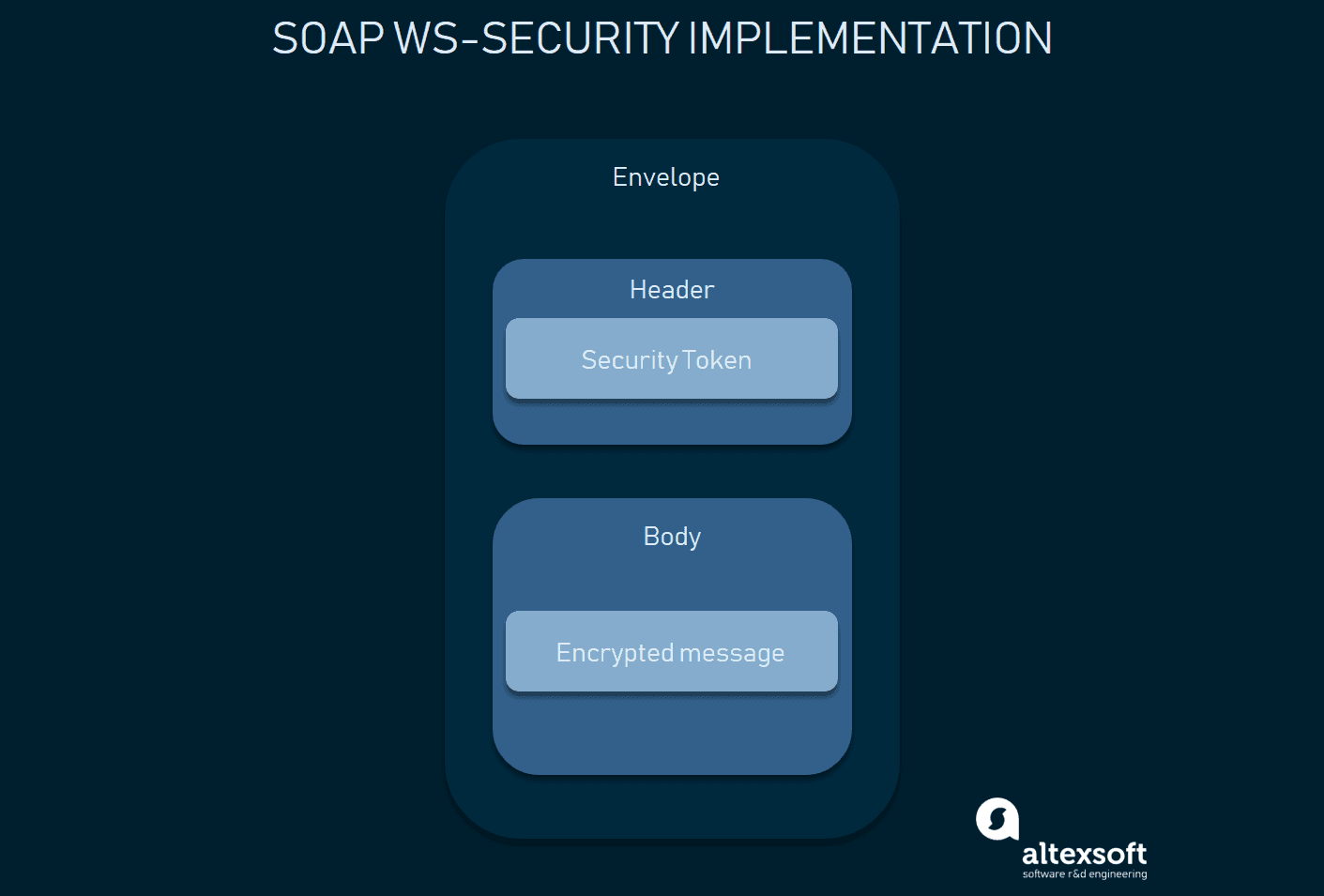
That's how WS-Security works with the message structure
Vittorio Bertocci, a Microsoft master programme manager, explained how WS-Security works using a naked motorcyclist metaphor.
Imagine your message as a naked motorcyclist. To accomplish the destination, he can drive through a transparent tunnel and hope that nobody sees him (HTTP). Or he can drive through an opaque tunnel. In this case, while nobody sees him when he's inside the tunnel, to accomplish the last destination, he still must ride beyond some streets (HTTPS is an opaque tunnel, patently). And finally, he tin just habiliment clothes and a helmet to experience completely secure (WS-Security).
This message-level security is why financial organizations and other corporate users opt for SOAP.
SOAP stateful and stateless messaging
The beginning of the 21st century is remembered for the internet boom. Thousands of net-driven companies were emerging and millions of users were accessing the web every 24-hour interval. Now imagine that a unmarried server starts receiving thousands of requests from users (clients) simultaneously. And if this resource does something more complex than show walls of text, things can get tiresome. For instance, if users check the upcoming flights schedule and must drill down to each flight detail, the server must be aware of what's happening with the client, correct?
Information technology appears that you can handle this situation in two ways: using stateful and stateless operations. And SOAP supports both.
Stateful means that the server keeps the information that information technology receives from a client across multiple requests. For instance, starting time it memorizes the flight dates that you're looking for and then provides information on the pricing later on the second asking. This allows you lot to chain letters together, making the server enlightened of the previous requests. Stateful messaging may exist crucial in operations involving multiple parties and circuitous transactions, due east.one thousand. bank operations or flight booking. But nonetheless, it's really heavy to a server.
Stateless communication means that each message contains enough information most the state of the client so that a server doesn't have to be bothered with it. Once the server returns requested data, information technology forgets about the client. Each request is isolated from the previous i. Stateless operations helped reduce server load and increment the speed of communication.
Stateful operations is i of the reasons Soap is used for banking concern transactions and other data commutation that requires chaining messages. More than on Soap utilise cases below.
Retry logic
When building a Lather API, developers can integrate successful/Retry logic. To put it just, if something goes wrong, a requesting party gets the XML bulletin with an error code and its explanation. So a client-side developer understands the reason behind the failure and tin tweak the request to get a successful response. This characteristic adds some confidence to the development process since you don't have to manually search the problem. Soap has a default specification to establish the response format.
SOAP is versatile, powerful, and very standardized. But the thing is, sometimes you lot don't demand the interface to be that rich. And Lather has several disadvantages that easily tip the scale in favor of Remainder for the bulk of engineers and their organizations.
Some Soap disadvantages to consider
Resource-consuming. Due to the larger size of an XML-file and a payload created by the massive structure of a bulletin, a SOAP API requires a larger bandwidth. Sometimes, this trade-off isn't worth dealing with. Simply put, it's irksome to procedure these strings of tags that XML letters abound with.
Hard learning bend. Beingness protocol-based, building Soap API servers requires knowledge and agreement of all protocols yous may apply with it. Developers dealing with building these types of APIs should dive deep into all processes within the protocol with its highly restricted rules.
Lacks flexibility. We've mentioned that a Lather API serves as a strict contract between a client and a server. With this in heed, this rigid SOAP schema requires boosted endeavour to add together or remove the bulletin backdrop on both sides of the communication, the server and the customer. Information technology makes updating requests and responses a tedious procedure and slows down adoption.
Getting started with SOAP: fundamental sources
If you're merely embarking on Soap engineering, here are the main links you should check:
SOAP Documentation – the key source of truth for those beginning piece of work with SOAP
Soap versions – as at that place were multiple iterations of the protocol, check these versions of SOAP
WSDL – how to employ Web Services Description Language and create WSDL documents
WS-Addressing – how to add routing information to Soap headers
WS-ReliableMessaging – the extension to brand sure that the messages arrive at their destinations. It too helps with making chains of messages
WS-Coordination – coordinating actions of distributed applications
WS-Security – how to enable message-level protection
WS-Atomic Transaction – how to make letters Acid-compliant
How SOAP compares to REST
When describing Soap, we must mention its main alternative – Rest.
Residual or representational state transfer is an architectural mode, rather than a protocol. What this means is that Remainder provides much more flexibility in terms of how you structure your bulletin, which format you utilize, and how the client and the server calibration. Soap, on the other hand, requires tight coupling betwixt client and server. If either side changes something, things go wrong, hence its protocol nature.
Residual was introduced in 2000 – it'southward not much younger than SOAP – with an idea of making servers intendance less near what's happening on the client.
And here'south where 1 of the main differences between Balance and SOAP begin.
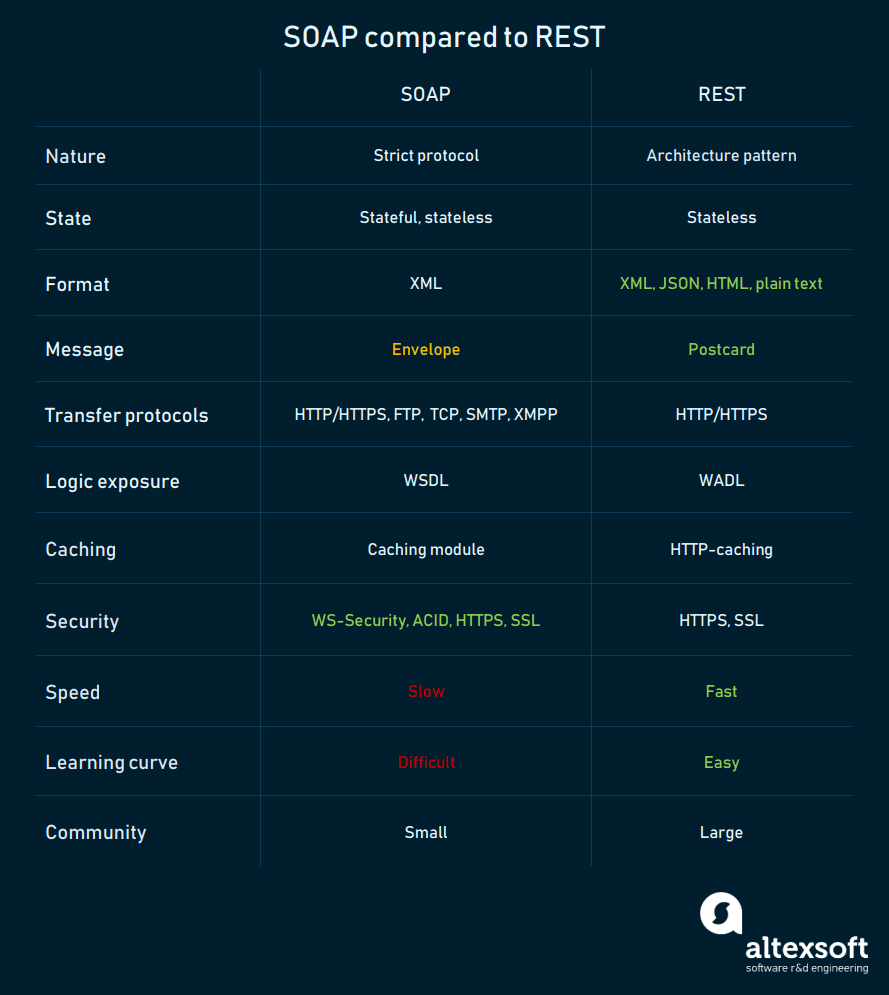
As most engineers will tell you lot, Lather and Residuum can't be directly compared, but since both approaches deal with solving a similar set up of problems here's a short breakdown
Stateful and stateless operations. REST is designed to be stateless; SOAP supports both approaches.
Message structure. While the Soap bulletin is an "envelope," the Residuum bulletin is on a "postcard": It has no actress wrappings or headers, or anything else that would alter its lightweight nature.
Logic exposure. In dissimilarity to Soap that keeps its logic in the WSDL document, Residue has its alternative – a WADL certificate (or Web Application Description Language dr.). It'due south not as common equally WSDL, but sometimes it'due south useful if you operate in a corporate environment and you can't easily contact people from the service side, requiring you to have some formal conventions at hand.
Information formats. Equally we mentioned, SOAP is strictly XML. Residual tin can operate with JSON, XML, HTML, and other formats you like. But JSON (or JavaScript Object Notation) remains the most popular.
Transfer protocols. SOAP is flexible in terms of transfer protocols to accommodate for multiple scenarios. REST is solely focused on HTTP/HTTPS substitution. There may be some exceptions if you map HTTP methods of exchange (GET, POST PUT, DELETE, etc.) to, say, FTP methods. Only Balance was designed with HTTP in mind.
Caching. Caching means storing some information on the client-side to avoid additional load on the server. For instance, you may cache non-dynamic content like images to load them faster on the client-side and avert requesting a server to exercise it every time y'all visit a resource. REST allows you to enshroud data on the HTTP level. If you want to implement SOAP-caching, you have to configure an additional cache module. Generally, Residuum is more than cache-friendly.
Message size. The absence of the overhead text and code blocks in the plain JSON file every bit compared to bulky XML in SOAP results in substantial size reduction. That is to say, a modest RESTful API's JSON file is easier and faster to procedure and transfer.
Learning curve. RESTful compages is straightforward and uncomplicated to attain. SOAP requires a much deeper understanding of standards and additional WS protocols. On acme of that, the engineering community that deals with REST is larger. So, you may wait to observe answers to problems much faster.
Mistake-handling. In dissimilarity to a SOAP API where specification allows for returning the Retry XML message with fault code and its explanation, a REST API leaves less room for transparency. REST mainly provides two options: The reply may comprise the mistake code without any explanation. This is a default characteristic. On the other hand, technology allows for the manual prescription of fault object along with its code.
Security. A Rest API uses Secure Sockets Layer (or SSL) along with HTTPS on tiptop of HTTP, having a unproblematic transport mechanism equally the encryption method. HTTPS coverage acts equally a shield for data security. And SSL security protocol is applied over an HTTPS connection to verify REST APIs calls. With Soap y'all can also utilize SSL, including TCP-messaging, on height of the message-level security.
Lather Use Cases
Considering these differences, information technology gets obvious why spider web messaging is mostly done with Remainder. To wrap things upward, let's ascertain the cases when SOAP is still the major technology.
Highly standardized operations: billing, navigation, facilities. All use cases where yous have to eliminate whatsoever kind of misinterpretation are a good fit for SOAP communication. Usually, these systems have strict contracts with clearly defined logic that can be described with a WSDL certificate.
Banking company transactions and payment systems. When you need your transactions to always be reliable and non-reachable by third parties, Lather has multiple benefits to consider. First, it's the level of security with Acrid compliance and WS-Security protocols. Additionally, this set of employ cases unremarkably requires stateful messaging, i.e. using chained transactions that aren't isolated one from another. Since payment systems may accept multiple parties involved in a single operation, Lather allows for better coordination of their behavior.
Flight booking systems. Since flying booking unremarkably involves multiple parties, some providers from this industry still rely on SOAP to handle stateful and chained messaging.
Not-HTTP messaging and legacy environments. If the server requirements and existing systems leverage advice protocols too HTTP, SOAP is the first option to look at.
This commodity is part of a series that covers various approaches to digital communication systems and standards. You may also desire to check out:
What's API?
GraphQL
Electronic Data Interchange (EDI)

Is Soap & Glory Makeup Hypoallergenic,
Source: https://www.altexsoft.com/blog/engineering/what-is-soap-formats-protocols-message-structure-and-how-soap-is-different-from-rest/
Posted by: weaverhousee82.blogspot.com
0 Response to "Is Soap & Glory Makeup Hypoallergenic"
Post a Comment